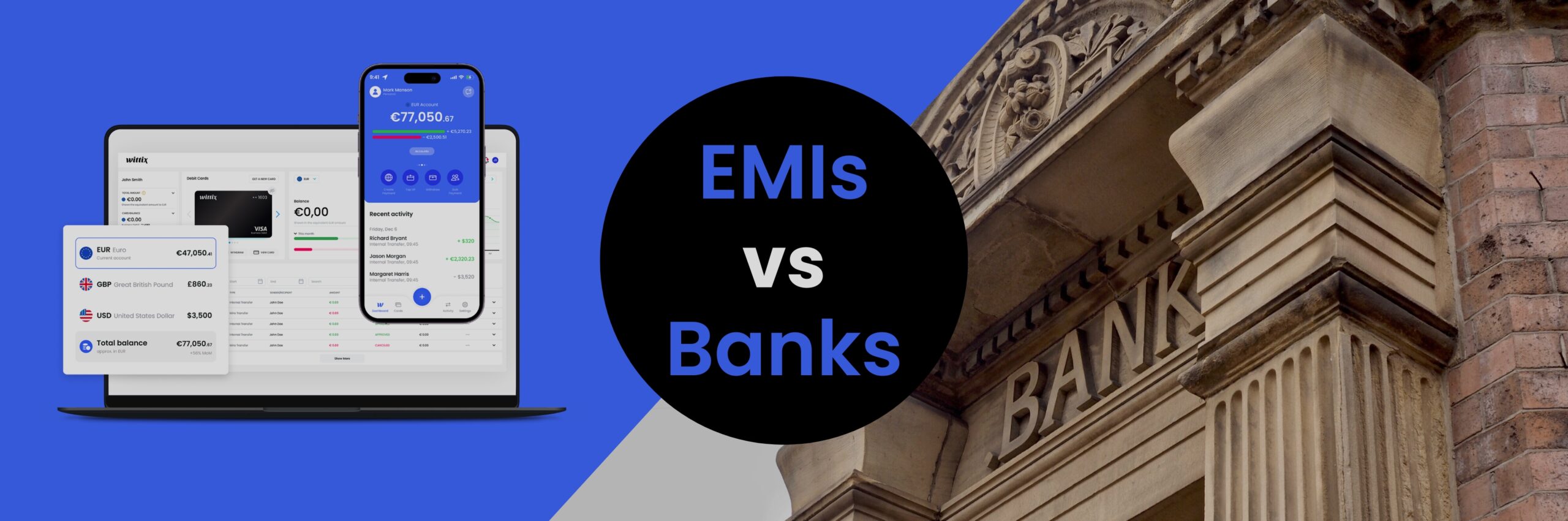
EMI vs Bank: The Quick Verdict
Topic |
Traditional bank |
EMI |
| Main use | Deposits, lending, banking | Payments, e-money, cross-border money movement |
| Lending | Yes | No |
| Fund protection | Deposit guarantee scheme | Safeguarding |
| Onboarding speed | Slower, can take weeks | Digital, typically a few days |
| Digital-first approach | Not always | Yes, by design |
| International transfers | Often slower, higher cost, single-currency focus | Usually faster and cheaper, multi-currency by default |
| Physical branch access | Yes | Typically no |
| Best for | Credit and large balances | Payments and international activity |
What is an EMI?
An EMI, or electronic money institution, issues electronic money and offers payment services. That includes business accounts, dedicated IBANs, SEPA and SWIFT transfers, and cards. The EU’s E-Money Directive (2009/110/EC) permits almost everything a business account needs, with one exception. An EMI can’t lend your money out.
A bank, however, works differently. Your deposit sits on its balance sheet, and the bank lends most of it back out as mortgages and business loans. An EMI never does that. Instead, it holds your funds in exchange for e-money and keeps them under strict safeguarding rules.
That single restriction explains nearly every EMI vs bank difference you’ll run into.
Why many international businesses choose an EMI
Picture a marketing agency invoicing clients in euros and pounds while paying a handful of freelancers abroad. It doesn’t need a loan most months. Instead, it needs an account that treats multiple currencies as normal, not as a forced conversion every time money lands.
That’s the gap an EMI closes. For example, accounts usually open within a few business days, not weeks. A business IBAN lets clients pay you like a local, even from another country. You can issue cards, often virtual, in minutes rather than days. Spend limits and team permissions come standard, not sold as an upgrade.
There’s a quieter advantage too: distance. Many European banks want a resident director or a local address before they’ll open an account. That’s a real problem if you register your company in one country but live in another. EMIs generally close exactly that gap, since remote onboarding is the default, not the exception.
When a traditional bank is still the better option
A construction company needs €400,000 to finance new equipment. No EMI can offer that loan, by law. Lending only happens through a bank.
That’s the honest limit of what an EMI does: overdrafts, credit lines, and business loans all require a bank. So does a full deposit guarantee. If a bank fails, an industry-funded scheme repays eligible deposits automatically, up to €100,000 per depositor, with no insolvency process to sit through. For businesses that lean on borrowing, or want a branch to walk into, a bank still earns its place.
Can you use both?
Plenty of businesses do, in fact. A common setup runs day-to-day payments through an EMI. A bank relationship stays in place for the moments borrowing comes up. Neither side has to lose for this to work, since the two accounts simply do different jobs.
Is an EMI safe? Safeguarding vs. deposit guarantee
Here’s what actually happens to your money. It never sits in the EMI’s own account. By law, the EMI holds it separately from the company’s operating funds. It sits at a credit institution or in low-risk assets, and the EMI never lends it out. So if the EMI ran into trouble, the law requires that money go back to clients first, ahead of any other creditor.
Regulators call this protection safeguarding. Unlike a deposit guarantee, though, it works quite differently. A bank can lend your deposit out, but backs it with a state-run guarantee capped at €100,000 per depositor. An EMI can’t lend your money at all, and there’s no cap on how much safeguarding protects.
That said, regulators have tightened safeguarding audits and reporting requirements in recent years. The goal: make sure this protection holds up in practice, not just on paper. Neither model is simply “safer” in the EMI vs bank debate. They’re different tools solving different problems. A bank spreads risk through lending. An EMI keeps client money out of its own business entirely.
Choosing the right EMI vs Bank provider
Once you know which category fits, the harder question becomes which specific provider does. Check a few things first:
- Check the provider’s licence number against the national regulator’s register, not just their own website.
- Compare the real exchange rate you’re offered against the mid-market rate. That’s usually where the actual cost of a transfer hides, more than in the flat fee.
- Ask exactly when they assign a dedicated account manager, if at all, and what triggers it.
- Find out whether the provider typically works with businesses like yours, or has a history of excluding entire industries regardless of individual risk.
- Confirm your directors’ country of residence fits the provider’s onboarding rules.
- Decide whether you’ll need a bank alongside this account for anything involving credit.
Wittix: the EMI built for your international business
Wittix is an EMI licensed and supervised by the Bank of Lithuania (EMI Licence No. 48). The account exists for one job: moving money across borders without the delays and currency conversions that come with a traditional bank.
That shows up as 35 currencies and dedicated IBANs in European countries and the UK, so a client paying you from abroad pays what looks like a local transfer. It shows up as a named account manager assigned before onboarding finishes, not after your volumes justify one. And it shows up as safeguarding: client funds held apart from Wittix’s own accounts, never lent out, under the same EU rules this article has been describing.
Cards, virtual and physical, come with real-time spend tracking, so paying a supplier or issuing a card to a new hire doesn’t mean losing sight of where the money went.
Frequently Asked Questions
Is my money guaranteed with an EMI the way it is with a bank?
No. EMIs do not participate in deposit guarantee schemes and do not offer deposit insurance. They protect funds through safeguarding instead: the EMI keeps money separate from its own funds and never lends it out. A bank’s guarantee scheme caps cover at €100,000; safeguarding has no cap but depends on correct execution. Different models, different protections.
Can an EMI give me a loan or an overdraft?
No. Lending is a banking activity, and an EMI cannot extend credit from client funds by law. If you need borrowing facilities, that’s a reason to keep a bank relationship.
Do EMIs offer the same account support as a bank?
It depends on the provider. Many banks reserve a named account manager for their largest corporate clients, and plenty of EMIs run on self-service support alone. A smaller number assign one from day one, not once a business has grown into a large account.
Can an EMI replace a bank entirely?
For payments, often yes. For lending, no. An EMI cannot offer loans, overdrafts, or credit lines under any circumstances, so a business that regularly borrows will still need a bank relationship alongside it.
Can a business use both a bank and an EMI?
Yes, and many do. A common setup keeps a bank for loans and large reserves, and runs everyday payments, payroll, and currency conversion through an EMI account instead.
About Wittix
Wittix, UAB is an Electronic Money Institution licensed and regulated by the Bank of Lithuania (EMI Licence No. 48), operating under the European Central Bank’s legal framework. We offer fully digital financial services for individuals and businesses, including multi-currency European accounts, SEPA and international payments, cards, and expense tools. Whether you’re scaling online or managing a more traditional operation, local or global, Wittix provides a platform that’s easy to use and a team that delivers real, personal support.
Learn more, speak with our team, or open an account at wittix.com.
Sources: EU E-Money Directive 2009/110/EC (safeguarding and activity rules); EU Deposit Guarantee Schemes Directive 2014/49/EU (€100,000 coverage level); European Banking Authority, Deposit Guarantee Schemes data; UK FCA safeguarding rules overhaul.
This article is for informational purposes only. Information accurate as of 10 July, 2026. This article is not intended to constitute financial advice.